

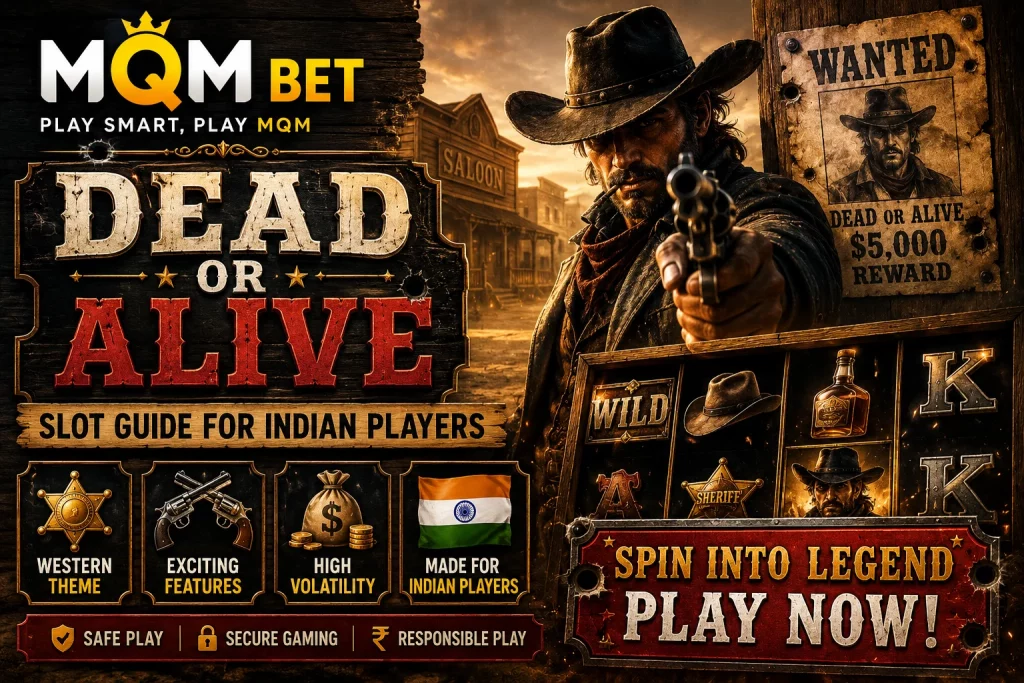
Dead or Alive is one of the most recognisable Western-themed online slots, known for its tense frontier atmosphere, wanted-poster styling, revolvers, saloon imagery, and a game rhythm that feels sharper than many softer casual titles. For MQM Bet, the page should present Dead or Alive as a slot guide with clear mechanical explanation, realistic expectation setting, and India-focused safety context. The goal is not to overstate the game’s appeal, but to explain why it remains a frequently discussed title among slot players and what readers should check before comparing it with other casino games.
The game’s identity is built around a classic outlaw setting. That gives the title a direct visual language: dusty colours, old-West symbols, tense sound cues, and a more dramatic style than bright fruit or jewel slots. This theme makes Dead or Alive easy to recognise in a casino catalogue, but the theme alone does not define the experience. A serious review must look at paytable structure, feature behaviour, volatility feel, mobile readability, and responsible session control.
Dead or Alive is often associated with a more intense slot experience because Western-themed games usually use suspense, scarcity, and feature anticipation as part of their appeal. That does not mean the game can be predicted or controlled. It remains a chance-based slot where each round is independent. A professional MQM Bet page should make this clear from the start, especially for readers in India who may be comparing slots across different categories and platforms.
The most useful way to introduce Dead or Alive is to separate atmosphere from mechanics. The atmosphere gives the game character. The mechanics decide how the session actually works. Readers should be encouraged to review the paytable, understand symbol values, check whether free spins or special symbols apply, and evaluate the game through rules rather than emotion. This keeps the article credible and avoids generic promotional language.
Why Dead or Alive Stands Out
Dead or Alive stands out because it has a stronger mood than many simple slot titles. The Western theme creates tension quickly, and the visual structure can make the game feel more serious than colourful arcade-style slots. For MQM Bet readers, this makes the game useful as a comparison point. It shows how theme can influence the feel of a slot even when the core result system remains random.
The game can appeal to readers who like a sharper, more atmospheric screen. Instead of relying on soft colours or luxury visuals, Dead or Alive uses a rugged frontier identity. Symbols connected to the theme help the game feel coherent. This matters because a coherent slot is easier to remember and easier to describe in a review. Readers can immediately understand the setting, even before studying the paytable.
However, the title should not be presented as suitable for every reader. Some users prefer calmer, clearer, lower-pressure game styles. Others prefer feature-heavy slots with modern animations and layered bonus systems. Dead or Alive belongs closer to a suspense-driven slot category, where patience, expectation control, and session discipline matter. A good page should explain that difference instead of using the same language for every game.
This is where internal navigation should feel natural. Readers who want a broader slot catalogue can continue through MQM Bet’s Slots section. Those comparing roulette, card titles, and slot releases can move into the wider Games area. Users reviewing account access should read the Login guidance, while new visitors should understand eligibility and verification before using any Sign up process. If the article later discusses offers, the Bonus page should be referenced carefully because promotional terms do not change random slot outcomes.
| Review Area | What Dead or Alive Brings | MQM Bet Editorial Note |
|---|---|---|
| Theme | Western frontier style with outlaw imagery, wanted-poster mood, saloon details, and tense visual identity. | Best reviewed as an atmospheric slot where theme strongly shapes the first impression. |
| Game Feel | Sharper and more suspense-driven than many bright casual slots, with a mood that can feel intense during longer sessions. | The review should explain expectation control and not present suspense as a winning signal. |
| Paytable Value | The paytable is essential for understanding symbols, line rules, features, and session structure. | Readers should study the rules before judging the slot by theme or reputation alone. |
| Mobile Context | The game can be suitable for mobile review if symbols, controls, and paytable access remain clear on smaller screens. | Readers searching for an Apк should avoid unknown files and rely only on verified access routes. |
| India Safety | Readers should consider eligibility, local rules, payment awareness, account security, and responsible gaming limits. | General digital safety information can be reviewed through MeitY, while financial awareness material is available from RBI. |
How to Read the Dead or Alive Paytable
The paytable is the most important part of a Dead or Alive review because it turns the theme into usable information. A player may recognise the Western symbols quickly, but recognition is not the same as understanding. The paytable explains which symbols carry higher value, whether special symbols exist, how paylines or combinations are counted, and whether any feature round changes the session structure.
For MQM Bet readers, the article should treat the paytable as a basic safety tool. It reduces confusion and helps readers avoid assumptions. A game with a strong reputation can attract attention, but reputation does not explain rules. Readers should know exactly where to find game information and how to interpret it before comparing Dead or Alive with other slots.
This is also the correct place to discuss volatility without exaggeration. Dead or Alive is often discussed as a slot with a more suspenseful profile, but the page should avoid making fixed promises about what a reader will experience. Volatility describes possible rhythm and variance, not a guarantee. A higher-intensity slot can involve longer quiet stretches and sharper feature anticipation. That makes budget and time limits especially important.
A strong review should also explain that feature anticipation can affect behaviour. When a slot uses suspense effectively, readers may feel tempted to continue because a feature seems close. The article should make clear that “close” is not a predictive signal. A near miss, repeated symbol appearance, or long dry stretch does not prove that a result is due. This kind of explanation makes the content more expert and more responsible.
Mobile Use and Account Awareness
Dead or Alive can be reviewed from a mobile perspective because many Indian readers browse casino content from phones. Mobile usability is not only about whether the game loads. It is about whether the symbols remain readable, whether stake controls are clear, whether the paytable can be opened easily, and whether responsible gaming tools are visible in the account area.
The article should avoid pushing mobile use as a shortcut. A phone can make casino content more convenient, but convenience also means sessions can start quickly and continue without much friction. For a suspense-driven slot, that matters. A reader should decide limits before engaging with the game, not after the session has already become emotional.
Account security should be handled in the same practical way. Readers should use strong passwords, avoid shared devices, check the platform’s verification steps, and be cautious with payment information. If a site has identity checks, withdrawal rules, or document requirements, those should be reviewed before any money-related decision. This gives the page a more credible India-focused tone.
Internal linking can support this structure naturally. Readers who need policy details can continue to the site’s FAQ. Those who want official resource references can use editorial Links where relevant. The important point is that navigation should answer real questions, not interrupt the article with raw URL-style phrases.
Editorial Position for Dead or Alive
Dead or Alive should be presented as a memorable Western-themed slot with a strong atmosphere and a sharper session feel than many casual titles. Its value in an MQM Bet guide is that it allows the article to discuss mood, volatility perception, paytable review, and expectation control in one place. That makes the page useful for readers who want more than a basic game description.
The title should not be described as predictable, easy, or strategically controllable. A reader can study the paytable, understand the theme, compare the slot with other titles, and set limits. A reader cannot use previous spins, near misses, or visual patterns to forecast results. That distinction should remain clear throughout the page.
For Indian readers, the safest editorial approach is balanced. Dead or Alive may be visually distinctive and widely recognised, but every session should be treated as entertainment-focused and risk-bearing. The page should encourage rule reading, account awareness, local eligibility checks, and responsible limits before any play-related decision.
Written with this structure, Dead or Alive becomes a strong content page for MQM Bet. It does not sound like a generic promotional review. It gives readers a reason to understand the game: atmosphere matters, mechanics matter more, and responsible control matters most.
Dead or Alive Volatility Profile and Session Rhythm
Dead or Alive should be explained through volatility, pacing, and emotional pressure. The Western theme gives the slot a tense identity, but the deeper point for MQM Bet readers is how that tension affects the way a session feels. A game can look simple and still feel intense if its rhythm encourages anticipation. That is why this page should not describe Dead or Alive only as a cowboy-themed slot. It should explain how the game’s style, rule structure, and possible feature behaviour shape the overall experience.
The title is often discussed by slot readers because it has a sharper profile than many casual games. A bright, low-pressure slot may create a relaxed browsing mood, while Dead or Alive uses suspense as part of its personality. Wanted-poster graphics, frontier styling, and darker tones make the game feel more serious. This can be attractive for readers who like atmospheric titles, but it also means session control becomes more important.
Volatility is not a prediction tool. It does not tell a reader when a result will happen. It only helps describe how uneven a session may feel. A higher-intensity slot can have quiet periods, sharper swings, and stronger feature anticipation. Readers should not treat repeated misses, long gaps, or near-feature moments as evidence that a result is close. Each round remains independent.
For Indian readers, the practical recommendation is to review Dead or Alive with discipline. The game’s theme can create strong attention, but the page should keep the focus on rules, limits, account safety, and realistic expectations. A professional casino guide should explain why the title is memorable without turning suspense into a promise.
How Volatility Changes the Way Readers Should Review Dead or Alive
A slot with a tense identity needs a different review approach from a soft casual game. Dead or Alive should be evaluated through what it asks from the reader: patience, rule awareness, and the ability to stop before the session becomes emotional. The game’s atmosphere can make a quiet stretch feel dramatic. That does not mean the slot is building toward a result. It means the design is doing its job by creating suspense.
This is where many shallow slot reviews fail. They describe a game as exciting but do not explain what that excitement does to behaviour. A suspense-driven slot can encourage the feeling that one more spin might change the session. A responsible MQM Bet article should make clear that this feeling is psychological, not mathematical. The game does not owe a result because a feature did not appear earlier.
The paytable should be used as the anchor. It gives readers a factual structure: symbols, line rules, possible special icons, feature conditions, and any relevant game limits. Without that structure, the review becomes based on emotion. Dead or Alive may have a strong reputation, but reputation should not replace rule reading.
For Indian readers, this distinction matters because online casino content is often consumed quickly on mobile. A reader may move from one title to another without studying terms carefully. A professional guide should slow that process down. It should explain what to check, why it matters, and how to keep casino content inside a controlled entertainment frame.
Feature Anticipation and Responsible Interpretation
Feature anticipation is one of the most important behavioural points in a Dead or Alive review. A slot with a suspenseful identity can make every close moment feel more important. A reader may notice repeated symbols, near combinations, or long stretches without a strong result and begin to treat those moments as signals. A responsible article should correct that interpretation clearly.
Near misses are not evidence that a feature is close. Repeated symbols are not proof that the slot is warming up. A quiet period does not mean a result is due. These are common player perceptions, but they do not provide a reliable basis for decision-making. The game’s outcome model remains random, and the screen presentation does not change that.
This is especially important when the game is played on mobile. Smaller screens can make the session feel more private and continuous. A reader may continue longer than planned because the game is easy to access and the suspense is contained inside a quick interface. MQM Bet should explain that mobile convenience should be paired with stricter personal controls, not looser ones.
A good review should therefore use Dead or Alive as an example of why emotional pacing matters. The game’s atmosphere is part of its appeal, but that same atmosphere is why readers need clear boundaries. It is possible to appreciate the design and still keep the session controlled.
Popular Slot Context for Indian Readers
Dead or Alive can be better understood when compared with other slot titles often noticed by readers in India. Different slots create interest in different ways. Some rely on bright simplicity, some on cascading mechanics, some on jackpots, and others on suspense-heavy themes. Dead or Alive belongs to the atmospheric and volatility-focused category, where the tone is more intense than casual visual slots.
Popular slot titles commonly discussed by Indian players include:
- Dead or Alive
- Starburst
- Gonzo’s Quest
- Pearls of India
- Book of Dead
- Sweet Bonanza
- Gates of Olympus
- Big Bass Bonanza
- Wolf Gold
- Mega Moolah
- Divine Fortune
- Legacy of Dead
This list should be treated as context, not as a recommendation ranking. Starburst is often recognised for its clean and simple visual style. Gonzo’s Quest is associated with falling-symbol mechanics and multiplier progression. Sweet Bonanza and Gates of Olympus are commonly discussed for cascading action and multiplier-driven feature design. Dead or Alive is different because its strongest identity comes from Western atmosphere, suspense, and volatility perception.
For MQM Bet, this comparison helps the page feel more editorial. It shows that the site understands category differences rather than forcing every slot into the same description. Dead or Alive should be positioned as a sharper, mood-led title for readers who want to understand how suspense affects slot experience.
MQM Bet Editorial View on Dead or Alive
Dead or Alive is a strong article subject because it gives MQM Bet a chance to discuss slot intensity in a responsible way. Many casino pages focus only on features and visuals, but this title needs more careful explanation. Its appeal comes from atmosphere, tension, and reputation, yet those same qualities require realistic expectation setting.
The best editorial view is balanced. Dead or Alive can be memorable, visually distinct, and engaging as a themed slot. It can also feel demanding because the session rhythm may create strong anticipation. A responsible guide should explain both sides without exaggeration. The reader should understand why the title is known, but also why session control matters.
This page should keep returning to the same expert principle: theme creates mood, rules define structure, and randomness controls outcomes. The reader can study the game, compare it with other slots, and decide whether the style suits their preferences. The reader cannot use suspense, near misses, or previous spins as a method.
Written this way, the Dead or Alive page becomes more than a slot description. It becomes a practical MQM Bet guide that helps Indian readers understand the title’s identity, evaluate its rules, and approach the game with clearer boundaries.
Dead or Alive Paytable Discipline and Player Awareness
Dead or Alive needs a careful review because its atmosphere can feel stronger than its visible simplicity. The Western setting is direct and memorable, but the game should not be judged only by saloon imagery, wanted-poster symbols, or suspenseful presentation. A serious MQM Bet page should guide readers toward the paytable first, because that is where the real structure of the slot is explained.
The paytable helps readers understand what the screen actually means. It shows symbol values, line logic, possible special symbols, and any feature conditions that may apply. This matters because a theme-heavy slot can make certain symbols look more important than they are. A revolver, sheriff badge, bottle, hat, or wanted sign may feel meaningful visually, but only the rules explain its actual role in the game.
For Indian readers, this section should also explain why reading the rules is part of safer casino behaviour. Many users compare slots by reputation, design, or short clips, but those signals do not explain how the title functions. A responsible guide should slow the process down and make practical checks feel normal. Before comparing Dead or Alive with other titles, readers should understand the paytable, account conditions, payment rules, and session limits.
Dead or Alive also makes a useful example of how emotion affects interpretation. A tense game can make a quiet run feel more dramatic. It can make a near miss feel important. It can make a feature seem closer than it is. The article should explain that these impressions are not reliable decision points. Random outcomes do not become predictable because the presentation feels intense.
Reading Symbols Without Overreading Patterns
Symbol reading is useful only when it is connected to the paytable. Dead or Alive uses a coherent Western style, so readers can recognise the theme quickly. That visual clarity can make the game easier to follow, especially when the screen is not overloaded. Still, the purpose of symbol recognition is not to identify patterns. It is to understand what the paytable says each symbol does.
A common mistake is treating repeated symbols as signals. If the same high-value icon appears several times without forming a result, it can feel like the slot is building toward something. A responsible review should reject that interpretation. Repetition on the screen does not create a reliable forecast. A close-looking result is not evidence that the next round is more likely to produce the desired outcome.
This is why the page should use precise language. It can say that Dead or Alive has a strong theme, suspenseful tone, and recognisable symbols. It should not say that the game can be read like a pattern. It should not suggest that patience forces the slot to respond. The correct explanation is simple: the game may create anticipation, but anticipation is emotional, not predictive.
For MQM Bet, this kind of explanation improves trust. It shows that the site is not just describing games for attraction. It is helping readers understand how online slots should be evaluated. That distinction makes the page sound more like a real expert casino resource.
Comparing Dead or Alive with Softer Slot Experiences
Dead or Alive is not a soft visual slot. Its mood is sharper, its theme is more dramatic, and its overall identity is built around frontier suspense. This gives the title a different role in MQM Bet’s slot coverage. It is useful for readers who want to understand how atmosphere can intensify a game without changing the underlying randomness.
Softer slots often rely on bright colours, simple symbols, and a low-pressure screen. They may be easier to browse casually because their presentation feels light. Dead or Alive uses a different emotional structure. It can feel more serious because the theme suggests pursuit, danger, and high-stakes frontier imagery. That difference should be explained clearly because it affects how readers perceive the session.
The comparison should not be turned into a ranking. A calmer slot is not automatically better, and a suspense-driven slot is not automatically worse. The point is suitability. Some readers prefer clean simplicity. Others prefer stronger atmosphere. A credible MQM Bet page should explain which type of experience Dead or Alive represents and what readers should check before choosing it.
This also helps avoid repetitive article style. Instead of calling every game exciting, the page gives Dead or Alive a specific editorial position. It is a tense, recognisable, mood-led slot where paytable reading and limit setting matter. That is more useful than generic praise.
Responsible Session Control for Suspense-Led Slots
The most important responsible gaming point for Dead or Alive is session control. Suspense-led slots can make a reader feel more invested in each spin because the theme creates pressure. This can make it harder to stop if the session begins to feel unfinished. A professional article should explain that stopping should not depend on whether the game feels close to a feature.
The safest approach is to decide limits before the session begins. That includes time, budget, and a clear stopping point. Once the session starts, the player should not change those limits because of emotion, frustration, or the feeling that a result is overdue. This is especially important for slots where the mood is intense.
The article should also explain that a feature not appearing for a while does not make it more likely to appear soon. Readers may understand this logically, but a tense game can still influence behaviour. That is why repeated reminders about randomness should be written in practical language, not as abstract warnings.
For MQM Bet, this responsible framing makes the page stronger. It shows that Dead or Alive is being reviewed as a real casino product with entertainment value and risk, not as a simple promotional item. The article can acknowledge the game’s appeal while still helping readers stay realistic.
Dead or Alive Final Review for MQM Bet
Dead or Alive should close with a clear editorial verdict: this is a suspense-led slot where the theme is powerful, the mood is memorable, and the reader must separate atmosphere from actual control. The Western setting gives the title a strong identity, but the game should still be reviewed through its rules, paytable, volatility feel, mobile usability, and responsible gaming context. A professional MQM Bet page should not present Dead or Alive as a predictable title. It should present it as a slot that needs careful expectation management.
The strongest feature of Dead or Alive is its mood. The frontier theme, outlaw symbols, darker colour palette, and tense pacing make the slot feel different from lighter casino games. This is useful for readers who want a more dramatic visual experience. At the same time, a dramatic theme can make a session feel more emotionally loaded. A quiet stretch can feel like pressure. A near miss can feel important. A feature that does not appear can feel overdue. None of these impressions should be treated as signals.
The final review should make one point very clearly: the game’s atmosphere changes how the session feels, not how outcomes are determined. Readers can study the paytable, compare feature rules, test mobile readability, and decide whether the style suits their preferences. They cannot forecast future spins from previous outcomes, symbol repetition, or emotional timing. That distinction is essential for any India-focused casino guide that wants to sound credible.
For MQM Bet, Dead or Alive is valuable because it gives the site a more serious slot review topic. It is not just a colourful title with a simple theme. It is a game that allows the article to discuss volatility perception, suspense, responsible stopping points, and the difference between entertainment and expectation. This makes the page more useful than a generic slot description.
Dead or Alive Final Editorial Diagram
The diagram below uses a transparent background, bright line styling, and light grid contrast. It shows how Dead or Alive should be understood across theme intensity, volatility awareness, feature pressure, paytable importance, mobile caution, and responsible control.
Final Checks Before Choosing Dead or Alive
The first final check is the paytable. Dead or Alive should never be reviewed only through its reputation or theme. The paytable gives the essential structure: symbol values, line rules, special symbols, feature details, and any conditions that affect the session. Readers who skip this step are judging the game by mood rather than information.
The second final check is volatility awareness. Dead or Alive can feel more intense than softer slot titles because its presentation builds suspense. That intensity can make the session feel dramatic, but it should not change the reader’s decision-making. A game that feels tense is not sending signals. It is simply using atmosphere to shape the experience.
The third final check is mobile control. A mobile screen can make access quicker and more private, which may increase the risk of continuing longer than planned. Readers should make sure they can see controls clearly, open game information easily, and access account tools without confusion. Mobile convenience should be paired with stronger boundaries, not weaker ones.
The fourth final check is stopping discipline. Readers should decide session limits before the game begins. Once the session starts, the limit should not be changed because of frustration, excitement, or the feeling that a feature is close. This is the difference between controlled entertainment and reactive play.
How Dead or Alive Fits MQM Bet’s Casino Content
Dead or Alive gives MQM Bet a different kind of slot page from theme-led jewel titles, bright casual games, or modern cascading releases. It brings a stronger emotional profile. That makes the article useful because it can explain how mood affects session interpretation. Readers should understand that tension and anticipation are part of the presentation, not evidence of what comes next.
This title also helps the site build more specific internal casino coverage. A strong casino website should not describe every slot in the same tone. Dead or Alive needs language about frontier atmosphere, volatility perception, feature anticipation, and disciplined stopping points. That makes it distinct from a guide about Starburst, Gonzo’s Quest, Pearls of India, or Sweet Bonanza.
The page should also connect naturally with safer reading paths. If a reader wants broader game comparisons, they can continue into category-level slot content. If they want account guidance, they can review platform policy pages. If they are comparing promotions, they should check terms separately and remember that offers do not change the random outcome model of a slot.
This is what makes the article feel like a real expert page. It does not force the reader toward a single conclusion. It gives them criteria: theme, paytable, mobile access, volatility awareness, and responsible boundaries. That is more valuable than repeating that the game is exciting.
Final Editorial Conclusion
Dead or Alive is a strong slot guide topic because it has a clear identity and a serious review angle. The Western theme gives it a distinctive mood, while the session style makes it important to explain volatility and expectation control. For MQM Bet, this means the article should be written as a practical guide, not as a simple promotional description.
The final position is balanced. Dead or Alive can be memorable, atmospheric, and engaging as a casino title. It can also feel intense, which means readers need clear limits and realistic expectations. The game should be understood through its paytable and rules, not through emotional impressions during play.
Indian readers should approach the title with the same checks they would apply to any online casino content: verify eligibility, read terms, understand payment conditions, protect account access, and set personal limits before any session. A dramatic slot theme should not override those steps.
Written this way, the Dead or Alive page gives MQM Bet a credible expert resource. It explains why the game is recognised, how readers should evaluate it, and why responsible control remains central from the first spin to the final decision to stop.
Dead or Alive FAQ for MQM Bet Readers
Dead or Alive is a Western-themed online slot known for its frontier atmosphere, wanted-poster visuals, tense mood, and sharper session feel. It is best reviewed through theme, paytable rules, volatility awareness, mobile usability, and responsible play context.
The game stands out because of its strong Western identity and suspense-driven presentation. It feels different from softer visual slots, which makes it useful for readers who want to compare atmosphere, volatility perception, and feature anticipation.
The visual theme is easy to recognise, but readers should still check the paytable before forming expectations. The paytable explains symbol values, line rules, special symbols, feature details, and any conditions that shape the game structure.
No. The Western theme affects atmosphere and visual identity, but it does not affect randomness. Wanted symbols, near misses, repeated icons, or dramatic screen moments should not be treated as signals about future results.
Volatility helps explain how uneven or intense a slot session may feel. It is not a prediction method. A tense session, a quiet stretch, or a feature that feels close does not mean a result is due.
Indian readers should check eligibility, local rules, platform terms, account verification, payment conditions, withdrawal requirements, and responsible gaming tools before making any money-related decision.
Dead or Alive can be suitable for mobile review if symbols, controls, stake settings, and paytable access remain clear. Mobile convenience should be balanced with secure access, device protection, and strict session limits.
No. A bonus may include separate terms such as wagering rules, expiry dates, eligible games, and withdrawal limits, but it does not change the random outcome model of Dead or Alive.
The safest approach is to treat Dead or Alive as entertainment-focused slot content. Readers should set a budget and time limit before any session, avoid chasing losses, and stop when the session no longer feels controlled.






Comments